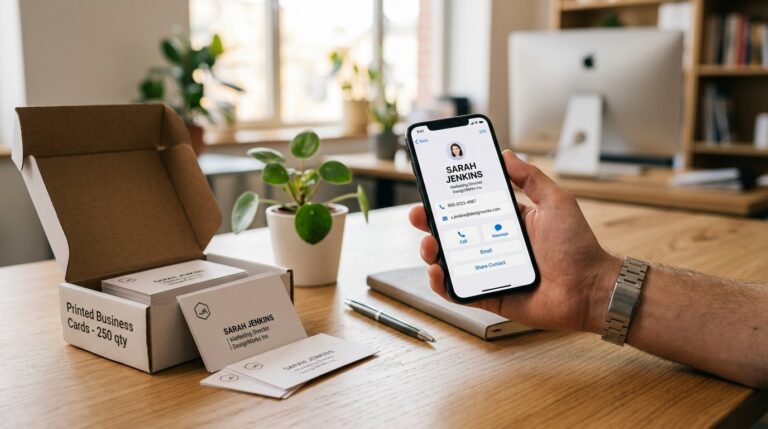
Conference Floor Strategy: How to Share Your Card Without Interrupting a Conversation

Most advice about networking strategy at conferences focuses on what to say. Very little of it addresses when to offer your contact details — and the timing, it turns out, matters more than the card itself. Get it wrong and a genuinely good conversation ends on an awkward transactional note. Get it right and the detail-swap feels like a natural next step that neither person had to think about.
This post is about the mechanics of that moment: when to offer, how to make it frictionless, and how a digital card changes what is actually possible in the middle of a busy exhibition hall.
The Problem with the Closing-Gesture Habit
The default behaviour at most events is to hand over a card at the end of a conversation, as a kind of punctuation mark. You have said what you wanted to say, the other person is already looking for an exit, and you press a card into their hand as they go. It is a habit inherited from a time when the card itself carried the information — when there was no other way to ensure they had your number.
The problem is that the closing-gesture moment is the worst possible time for information retention. Both parties are already mentally moving on. The card goes into a pocket or a lanyard bag, and the context that made the conversation worth having starts to fade the moment you separate.
There is a better model, and it requires rethinking what the card exchange is actually for.
Early in the Conversation: The Frictionless Detail-Swap
The most underused moment in a conference conversation is the first ninety seconds. You have introduced yourself, you have established enough common ground to know the conversation is worth having, and you are about to go deeper. That is exactly when a brief detail-swap serves both people.
It is not a pitch. It is an acknowledgement that you are both professionals who have better things to do than spell out an email address twice. “Here — easiest way to keep this going” is a complete sentence. The other person opens your card in their browser, saves your details, and you both get back to the actual conversation.
The reason this works better early is that the context is still live. They are saving your contact while they are still interested in what you are saying. The card becomes a bookmark for the conversation, not a receipt for it.
A digital card is particularly well suited to this moment because the recipient does not need to download anything or create an account. They tap or scan and your profile opens directly in their browser. See how the sharing process works — the friction is low enough that it does not interrupt the conversation’s momentum.
Reading the Room: When Not to Offer
A good networking strategy at conferences also means knowing when to hold back. Some situations actively work against the early swap:
- Group conversations. Offering your card to one person in a group of four signals that you have already decided who matters. Wait until the group naturally breaks into smaller clusters, or until a one-to-one moment opens up.
- The first ten seconds. If you have not yet established why the conversation is worth having, a card offer reads as a sales pitch rather than a professional courtesy.
- When the other person is visibly mid-task. Someone checking their phone, looking for their seat, or clearly on their way somewhere is not ready for a detail-swap. A brief, well-timed introduction is better than a full card exchange in those moments.
The underlying principle is that the card exchange should feel mutual. If only one person is offering, the dynamic is already off.
The Warm Introduction: Using Your Card for Someone Else
One of the least-discussed applications of a digital card is the third-party introduction. You are talking to someone, and you realise they should meet a colleague or contact who is not in the room. A digital card lets you pull up that person’s profile immediately and share it — not a phone number typed into a text message, but a complete professional profile the other person can save on the spot.
This is a genuinely useful thing to be able to do in the middle of a conference conversation. It positions you as a connector rather than a seller, and it gives the person you are introducing a warm entry point rather than a cold contact request later in the week.
The mechanics are simple enough that they do not interrupt the flow of conversation. That matters. When someone saves a shared card to their contacts, the details go in cleanly — name, role, phone, email, links — without the other person needing to do anything beyond a tap.
What Your Card Needs to Do in That Moment
If you are going to offer your card early in a conversation, it needs to be complete and current. A profile with a job title that no longer reflects your role, or a phone number that has changed, undermines the whole exchange. The person saves your details in good faith and then cannot reach you.
This is one of the practical advantages of a digital card over a printed one: when a detail changes, you update the profile once and every future share reflects the new information. There is no version control problem, no stack of cards with the old number sitting in a drawer. Keeping your profile current takes a few minutes and it means the card you share at 9am on day one of a conference is just as accurate as the one you share at 4pm on day two.
Beyond accuracy, think about what the profile communicates at a glance. Your role, your company, a direct contact method, and enough context for the other person to remember who you are when they look at their contacts list three days later. A profile that requires the recipient to already know who you are is not doing its job. What a well-built digital card can carry goes well beyond what fits on a printed card — video, links, social profiles — but restraint is still a virtue. The goal at the moment of exchange is clarity, not comprehensiveness.
After the Event: The Follow-Up Window
The follow-up window after a conference is shorter than most people assume. The first working day back is when the conversation is still fresh. By the end of the week, the context has blurred. By the following Monday, many contacts have mentally filed the interaction as background noise.
A good networking strategy at conferences does not end when you leave the venue. It includes a plan for what happens to the contacts you made. If you have been sharing a digital card and using one to receive details, you have a record of who you spoke to and when. The Contacts History Tab in BONKT tracks that sequence, which is useful when you are trying to reconstruct a busy two-day event from memory.
The follow-up message itself is outside the scope of what any card can do. A digital card is not a substitute for a well-considered email or a LinkedIn message that references something specific from the conversation. It is the mechanism that ensures the other person has a reliable way to respond when you do reach out — and that you have a reliable record of who you spoke to.
A Note on NFC Cards Versus QR Codes at Events
Both work. The practical difference at a conference is environmental. In a noisy exhibition hall with variable lighting, a QR code scan requires the other person to open their camera app, hold it steady, and wait for the code to register. An NFC tap is a single gesture. In a standing conversation with drinks in hand, that difference is noticeable.
The reverse is also true: in a setting where phones are already out and cameras are active — a product demonstration, a panel session, a networking breakfast — a QR code is entirely natural. Having both options available means you are not making a decision for the other person about how they prefer to receive information.
BONKT profiles support both sharing methods, and neither requires the recipient to have the app or an account. They tap or scan, the profile opens in their browser, and they save your details from there.
The Habit Worth Building
Networking strategy at conferences is, at its core, a set of habits. The habit of offering your card early rather than as a closing gesture. The habit of keeping your profile current before you travel. The habit of following up while the context is still live. None of these require a particular tool — but a tool that removes friction from the detail-swap makes it easier to build the habit in the first place.
If you want to see what the setup looks like before your next event, you can create a BONKT account at no cost and have a profile ready to share in under two minutes. The free tier includes a QR code and basic sharing — enough to test the early-offer approach at your next event before deciding whether the full feature set is worth it.
The conversation is still the thing. The card is just the mechanism that makes sure it goes somewhere.