How to Follow Up After a Networking Event Without Being a Nuisance

The window after a networking event is shorter than most people think
You met a dozen people. You exchanged details. You meant to follow up. Then Monday arrived, and by Wednesday the whole event felt like a month ago.
Most professionals know they should send a networking follow up message after an event. Far fewer do it in a way that actually moves the relationship forward. This post is about the mechanics: when to send it, what to say, and how to make it feel useful rather than pushy.
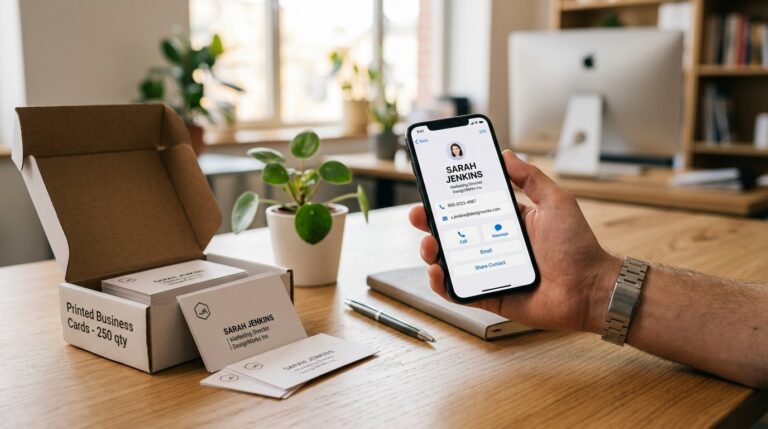
The card you shared — or the digital contact profile you sent via QR code or NFC tap — is background infrastructure here. The follow-up is the work.
Timing: the 24–48 hour rule has a reason behind it
Send your message within 24 to 48 hours of the event. Not because of some arbitrary etiquette rule, but because that is the window in which the other person still has context for who you are.
After 48 hours, the conversation you had starts to blur with three others they had the same day. After a week, you are a name they vaguely recognise. After two weeks, you are a stranger asking for something.
If you genuinely cannot send anything substantive in that window, at least send a short holding message — “Good to meet you at [event] yesterday, I’ll follow up properly later this week” — and then actually do it. A placeholder beats silence, as long as you follow through.
What to put in the message itself
The single most common mistake in a networking follow up message after an event is writing something so generic it could have been sent to anyone. “Great to connect, hope we can work together” is not a message — it is a formality. The other person reads it, feels nothing, and files it away.
A message that lands does three things.
1. It references the specific conversation
Name something you actually discussed. Not “we had a great chat” — that proves nothing. Something like: “You mentioned you’re rolling out a new tendering process across three states — I’ve been through something similar and found the bottleneck is usually in the handover between site and head office.”
That sentence does more work than a paragraph of pleasantries. It tells the other person you were listening, and it gives them a reason to reply.
2. It adds something useful, without a catch
If you can include something genuinely relevant — an article, a contact, a framework, a question — do it. Keep it short. One thing, not three.
The key word is “useful”. Not useful-to-you. Useful to them. If the only thing you are offering is a sales pitch, save it for a later message when you have earned a bit more trust.
3. It makes a clear but low-pressure next step
Give the other person something easy to respond to. A specific question works better than an open invitation. “Would it be worth a 20-minute call to compare notes on that?” is easier to answer than “let me know if you ever want to catch up.”
One ask. Keep it proportionate to how well you actually know each other — a 20-minute call is reasonable after a good conversation; a full meeting request is not.
The problem most people don’t notice until it’s too late
Here is the practical gap that kills most post-event follow-ups: by the time you sit down to write the message, you have forgotten the detail that would make it land.
You remember the person’s face and roughly what they did. You cannot remember the specific thing they said about their procurement challenge, or the name of the project they mentioned, or whether they were moving offices in October or November.
That detail is what turns a generic message into a specific one. Without it, you default to pleasantries.
Where the Contacts History Tab comes in
BONKT’s Contacts History Tab is designed for exactly this gap. When you save someone’s details after they share their digital card with you, you can add a note at the point of contact — while the conversation is still fresh. What they mentioned, what you offered, what the follow-up hook is.
That note is there when you open your messages the next morning. You are not reconstructing a conversation from memory; you are reading back what you captured in the moment.
It is a small habit shift, but it is the one that separates a follow-up that references something real from one that could have been sent to anyone.
You can read more about how the platform works — including how contact profiles are shared and saved — at the BONKT knowledge base, or get an overview at How It Works.
Tone: confident without being presumptuous
The tone that works best in a networking follow up message after an event is somewhere between warm and professional. Not stiff, not over-familiar.
Avoid language that implies the other person owes you something. “I just wanted to check in” is passive and slightly apologetic. “Following up on our conversation about X” is direct and purposeful.
Also avoid language that overstates the relationship you have. You met once. “As we discussed” is fine. “As my colleague” is not.
Match the register of the event and the person. A follow-up after a formal industry conference reads differently from one after a casual industry drinks. Neither is wrong — they just need to fit the context.
What to do when they don’t reply
One follow-up with no response is not a signal to abandon the relationship. It is a signal to wait.
A second message, sent two to three weeks later, is reasonable if you have something new to offer — a relevant article, a development in whatever they mentioned, an event you think they might find useful. Frame it around the new thing, not around the fact that they did not reply to your first message.
After two messages with no response, let it rest. Some conversations do not go anywhere, and that is fine. Networking is not a numbers game where persistence always wins — it is about finding the people where there is genuine mutual relevance.
When you are managing follow-ups across a whole team
If you are a team leader or manager who sends people to events, the follow-up problem scales. Ten people at a conference can generate a hundred conversations, and there is no consistent way to capture or act on any of them unless you build a system.
BONKT’s platform includes CRM integration via Zapier and Pabbly Connect, which means contacts captured through digital card exchanges can flow into Salesforce or HubSpot without manual data entry. That does not replace the follow-up message — nothing does — but it removes the administrative step that often causes the follow-up to never happen at all.
For teams of ten or more, the platform’s team features also give managers visibility across how the team is sharing and connecting, which makes it easier to coach on follow-up practice rather than guessing.
The card is not the relationship — the follow-up is
A digital business card, like a paper one, is a mechanism for exchanging contact details. It does not create a relationship. It creates an opportunity for one.
The follow-up is where that opportunity either develops or disappears. Getting the timing right, referencing something specific, adding something useful and making a low-pressure ask — those are the habits that turn a brief conversation at an event into a professional relationship worth having.
The infrastructure that supports those habits — capturing notes at the point of contact, having details ready when you sit down to write — is worth thinking about before your next event, not after.
If you want to see how BONKT handles the contact capture side, this overview explains how digital cards work in practice. Or if you are ready to set up a profile, you can create a BONKT account — the free tier is there with no time limit and no credit card required.